Ohad Pele, 2021–2026
Sex is a portal. It is a beautiful, magnificent gate to the upper worlds, yet only a few pass through this gate. Most people, like tourists, come for a moment, take a selfie at this lovely gate, and move on to the next attraction. Most of them don't even know that one can pass through the gate into the garden. Into the Pardes, the Orchard of love.
With practice, lovemaking can become a spiritual journey. As on any journey, there are thousands of steps in it, each step a station in its own right. In this short essay, I will sketch one particular map of this Pardes of love, with four levels of practice and realization, but one must always remember that the map is never the territory.
The four worlds in question are four different fields of consciousness, each loftier than the one before it and, at the same time, more inward. The way from world to world is not so much an ascent as a consent of consciousness to enter deeper — lifnei ve-lifnim, inward and further inward.
The first world touches the plain sense of things, the Peshat, and it is the World of Asiyah.
The World of Asiyah: Freeing the Body from the Chains of Shame
The World of Asiyah is the world of the body and of physical sensation. In the practice of Asiyah, we need to know our own body and the bodies of our partners the way artists know the instruments of their art: as a pianist knows the keys, a guitarist the strings, a painter the brushes.
Whoever wishes to learn the art of sacred sexuality must develop a healthy curiosity and explore the many sides of the sexual realm without shame. They must free themselves from the chains of guilt, shame and fear that were programmed into their system in childhood, and that keep them from exploring in depth their own sexual body and the bodies of others. After all, if a pianist is afraid to try different kinds of music, her growth as a musician will be limited. If a painter feels guilty about taking hold of the pencil, no great work of art will ever come from that hand.
For the artists of love, the body is both brush and canvas, and it must be known from every direction. And so at the level of Peshat — the plain sense, from the same root as lehitpashet, to undress — we strip: not only of clothes, but of the limitations, shames and blocks that keep us from knowing the instrument of our art.
In our age it may be important to stress that sacred sexuality is not reserved for the young and well-toned body. The body you have is the brush, it is the canvas, it is the guitar or the trombone. Every great artist knows that art is made with what there is, and that no limitation is an excuse for not creating. For a true artist, every limitation is nothing but an invitation to a greater and more particular creativity. So whether you are fat as a hippo or thin as a twig, tall as a giraffe or low as a lizard, wrinkled as an old lion or light as a hummingbird; whether you are missing a leg, or have six fingers and two openings in your vagina (yes, such people exist) — this body that you are living in is the instrument through which you will make the revolution!
If you wait for the day you'll look like some model you carry in your head, you will never set out. Enslaving our real body to the models of the "sex idols" that consumer culture has so willingly supplied is the most widespread idol worship of our time.
To escape the trap of shame we have to do conscious work, aimed at releasing limiting beliefs and fixed patterns of thought. Swimming in the nude, walking naked in nature or at home, curious exploration (with consent, of course) of other people's bodies, of every color and type — exploration that is not part of sex but a kind of shared study — all these are a small part of the possibilities for practice in the Peshat of the World of Asiyah.
Freeing the body from the prison of shame also involves freeing the voice, the breath, and movement. So spontaneous dance between the supermarket’s aisles, or singing in the shower, can be a valid part of the practice too.
When the body releases the tensions stored in it, it sheds layers of armor that have built up over the years. A person's overall vitality rises as the armor falls. Someone who lives at peace with their body and their desires will be more spontaneous, more curious, more positive and, all in all, more alive.
In my many years of teaching in the field of shamanic sexuality around the world, I have seen countless men and women truly come back to life through this work. Something is released in them, and it affects every area of life.
In the World of Asiyah, embodied humans meet and agree to be together in a space where it is permitted to see and be seen, to smell, to touch, and to taste — like artists getting to know the materials of their craft.
The World of Yetzirah: Freeing the Heart to Love Greatly
In the World of Yetzirah, we are asked to open emotionally toward the other. Hebrew is a shamanic language of the first order, and so it hints that every emotion is a bridge: regesh, emotion, is gesher, bridge, with its letters rearranged. Emotions are meant to serve as bridges between our inner world and outer reality, between our heart and the heart of another.
The World of Yetzirah is the realm of Remez, the hint, in the Pardes, where one thing hints at others. A single stroke or spoken word can awaken a whole emotional world stored in our brain as a datum from the past. The heart wants to open but fears being hurt. It wants to bond but fears being abandoned. To avoid pain and emotional flooding, all of us developed defense mechanisms of one kind or another in childhood. Most human beings run like automatons. Defense mechanisms are triggered unconsciously because something that happened hints at, and reminds them of, something from the past that lives in the unconscious—and they attack, quarrel, rage, take offense, or disconnect and go somewhere else physically or mentally.
The challenge facing those who enter the Pardes of love is to notice, in real time, the defense mechanisms awakening, and to disarm them. Not to let them sabotage the relationship. To agree to feel the fear and the trembling that the defense mechanisms are trying to keep us from feeling.
I often like to pray: "May our love be greater than our wounds." We are all emotionally wounded, some less and some more, and we know that hurt people hurt people. So it is very likely that our wounds will tempt us to hurt others. Those who enter the Pardes of love stand guard, weeding the thorns from the field, and do not let these emotional wounds rule their lives.
They know they can be the ones who, even if they were hurt in the past, have no interest in passing the hurt on — because they seek to bring healing, not revenge.
It ain't easy.
In the days in which I write this essay, our world is overwhelmed with victim consciousness that has turned very aggressive. A consciousness that is lacking awareness, that has no interest in healing the field it lives in, because, like heroin addicts, it gets an instant dopamine fix from creating drama, getting likes on social media, and from the affirmation of self-righteousness. Presumably this will pass too. Evolution will not stop there. But even as it is still the norm, those who enter the Pardes of love face the challenge of noticing their own victim consciousness — and not falling victim to it.
In the most challenging moments, when all my bodymind wants is to defend, withdraw or attack, I am called to stop, breathe, and dare to descend to a greater emotional depth. I can ask myself, for example: What am I trying to protect? What is the sensitive spot that just got pressed? What am I trying to cover up? What are my defense mechanisms trying to keep me from feeling, and why? In these moments of grace, I can ask myself what I need to open the fortress of the heart and lower a bridge over the moat around it, so I can make contact with the beloved who is with me.
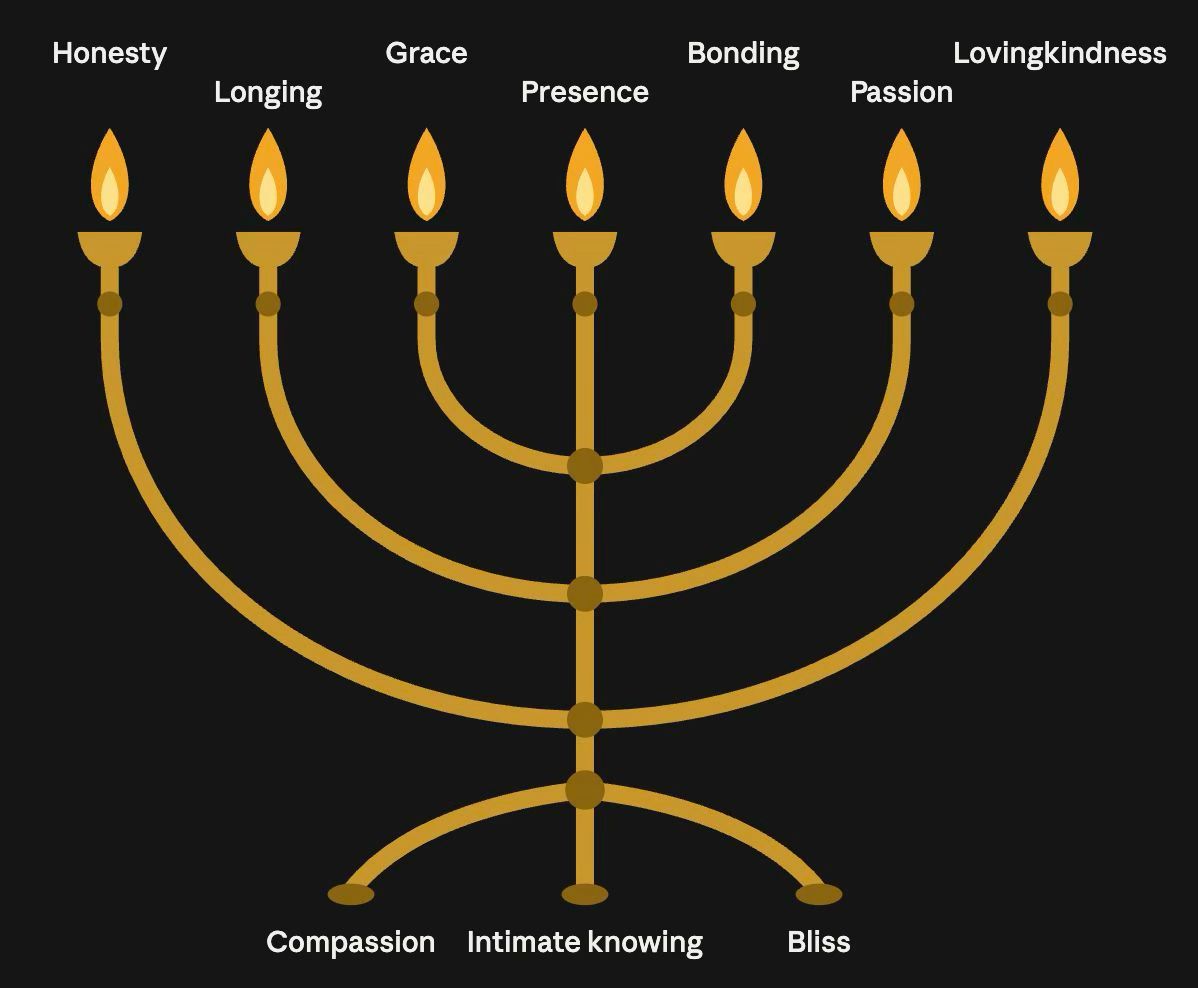
The seven qualities of our heart, the seven middot, are the seven lamps of the seven-branched Menorah in our inner Temple. The work of the World of Yetzirah is to raise the light in all seven branches of the Menorah within us, so that our whole emotional world shines and gives light.
In the World of Asiyah we acquire bodily freedom; in the World of Yetzirah we acquire emotional freedom — which is the freedom to love.
To love with Great Love, the heart has to go free. Ahavah Rabbah, Great Love, is the name for a love that is not just a pleasant feeling arising when everything flows in harmony, but a love that is the force of a choice. It is love as a way of life, which we choose even when all kinds of triggers are being pressed.
As our heart opens, emotions begin to flow, and to avoid blocking them, we must agree to touch places that are more and more vulnerable and tender. Tears are inseparable from the field of love in the World of Yetzirah.
The love that opens at this level is not confined to our partner alone — it overflows its banks and spills, through the person in front of us, out to the world and all that fills it.
That is why, when we meet people who have made love and opened body and heart, we feel they are shining, radiant, and more positive. It was from this place that those who said "Make love, not war" said it — because when Great Love opens, it becomes a way of life in which we feel the other, in their uniqueness and their holiness. Even if the other is different from us, even if there is conflict between us, the last thing we feel like doing is destroying and killing them. The longing to find harmony between opposites grows stronger the more we practice lovemaking in the World of Yetzirah.
The World of Beriah: Freedom from the Illusion of the Other
So far we have been speaking about "the gate". We reached it, felt it, took in its details, were moved by its beauty and savored it. But we have not yet passed to its other side. That is: even if we have opened physically and emotionally, we have not yet crossed into altered states of consciousness.
Entering the worlds of Beriah and Atzilut requires passing through the portal, which means leaving the ordinary state of consciousness and entering altered states. As we know today from neuroscience, sex releases a wide range of hormones and neurotransmitters that can bring a person into states of trance — just as if they had taken "drugs". But unlike mind-altering substances that come from outside, the substances produced within us arrive as an invitation that is easy to decline. Most people do in fact decline it or, more accurately, ignore it. Why? Because all the sex-education programs, even the best of them, do not teach us that a psychoactive invitation exists in sexual arousal at all, and no one guides us in how to accept that invitation and enter the gates of trance. Messages about physical and emotional sexuality reach us from many directions, but it is very rare to find messages about psychoactive sexuality, let alone to receive guidance in this mysterious field (Dawn and I teach it in the KabaLove Body Temple workshops and in private work).
What happens in the soul when we learn to recognize that invitation and cross the threshold of the gate into the spaces beyond is hard to describe in the language of sober, everyday reality. Here we need a mystical language, one that grows more paradoxical the deeper we go into the Derash and the Sod in the Pardes of lovemaking.
In the World of Asiyah, the world of Peshat, we stripped off the shackles of shame and guilt. In the World of Yetzirah, the dimension of Remez, we trained ourselves to notice the hints by which the soul is cued in the emotional realm. In the World of Beriah, something else happens. Illusions that could still hold in the World of Yetzirah must dissolve at the gates of the World of Beriah. Unlike yetzirah, formation, which is the giving of form to something that already exists, beriah, creation, means the appearance of Something out of Nothing: Yesh from Ayin. The Ayin, the Nothing, is the World of Atzilut, but the point of passage between Nothing and Something occurs in the World of Beriah. Coming down from above, the World of Beriah is the passage from Nothing to Something; but coming up from below, or from the outside in, the World of Beriah is where Something loses its somethingness and prepares to return to the Nothing. This is why Kabbalah identifies the "Chamber of the Holy of Holies" with the World of Beriah.
One arrives at the World of Beriah riding high waves of pleasure. This is what one of the great Ḥasidic masters, Rabbi Barukh of Kosov, understood when he grasped, "by supernal grace", that the holiness of the sexual act is drawn down precisely "through the feeling of physical pleasure — and this is a wondrous, deep and awesome secret."
During sex, the brain secretes delicious cocktails of mind-altering substances, and if we do not ignore them, come quickly and reach for a cigarette, we can surf the waves of pleasure into a deep mystical journey.
On this journey, our perception of reality changes. We suddenly get it: "All is One." Separateness is an illusion. The soul opens to recognize that nothing at all is foreign, and we are freed from otherness. In Hebrew, which is a shamanic language, the passage from the word aḥer, "other", to the word eḥad, "one", is marked by the addition of a small yod, which symbolizes the indwelling of the holy spirit, to the back of the letter resh. That addition turns the resh into a dalet, אחר ← אחד, and the other becomes part of the One.
The Zohar says that the union of male and female in the level of briah is constant, and that they are like "two companions who never part." Male and female are in a perpetual union that never ceases.
Whereas in the World of Yetzirah the masculine and feminine principles appear through separate people, in the World of Beriah our perception of reality changes and we dive to a more inward level of awareness. The boundaries that distinguish one thing from another dissolve, and consciousness opens to recognize that in truth "there is no other". When the distance between one thing and another dissolves in our mind, we become aware of a unified field of which everything is a part: "YHWH is One."
This is the place of Derash: here there is room to inquire, that is, to ask the deepest existential questions. Great insights can dawn in our minds when the brain can connect things that ordinarily seem far apart.
When the stranger within us stops being so strange, a dive into the shadow becomes possible.
The Zohar holds that in the realm of Binah, which is bound up with Beriah, there is room for deep inquiry. I love the verse in the prophet that links the word she'elah, question, with She'ol, the underworld. Isaiah says (7:11):
Ha'amek she'alah o hagbe'ah le-ma'lah
"Make your asking deep, or lift it high above." The author of Metzudat David explained that this is an invitation to ask "in the depth of the abyss or in the heights of the heavens above."
In the ordinary state of consciousness, where the shadow is perceived as a dangerous enemy of the ego, we do not like asking questions that open the doors of She'ol. But in the World of Beriah we are charged with a consciousness that allows us to raise questions that open up the abysses of the soul. The clearer it becomes to me that "there is no other", the less my shadows threaten me. I begin to feel curious about aspects I have not yet given room to within me, even when they surface as a reflection in the mirror of another—who ceases to be truly "someone else".
Something similar happens in MDMA-assisted therapy: this blessed substance generates in the brain a feeling of connection and infinite love. The patient feels held enough by this great love of the universe to touch shadows and traumas without shattering. The constant union of the inner masculine and feminine gives the soul a firm ground of love. A stability on which one can stand and look straight into the abysses. A compassionate gaze, with the power to heal the brokenhearted.
The World of Atzilut: Freedom from the Illusion of the I
The World of Atzilut is the Sod, the secret, of the Pardes. A secret not because it is kept from being told, but because these are things that cannot be spoken. Either the secret is revealed to you, or it is not. And even if it was granted to you and you grasped the secret, in a few hours or days you yourself may understand nothing. "All is sealed as before" (Zohar).
The great Ḥasidic masters taught that the World of Atzilut is not only somewhere up in the heavens, or in some other place, but also right here: "Atzilut is here too!" (in the name of the Maggid of Mezeritch). The truth is that everything is divinity, and "the obstruction (to grasping this is only) on the side of the receivers," wrote Rabbi Shneur Zalman of Liadi. Rabbi Kalonymus of Piaseczno added: "In truth, all is divinity. One needs only eyes to see, and a body that is becoming holy."
The World of Atzilut is the Ayin, the Nothing beyond Something, so when one enters the World of Atzilut, the I itself disappears. Ani, "I", becomes Ayin, "Nothing": the same three Hebrew letters, rearranged. אני ← אין
But because our ego is terrified of becoming nothing, it will do everything it can to distract us at exactly the right moment and keep us feeling like we exist.
In sex it is very common to pass, for a split second, through a state in which the I disappears. The parts of the brain busy producing the continuous "I" switch off for a moment during orgasm, and the image of the "I" that appeared on the screen of consciousness simply vanishes from it when the network is disconnected.
A person who passes through the gate of Atzilut cannot tell about it afterward, simply because "they" disappeared — so in fact “they” were never there. That is why it is a secret.
In the Solomonic Temple, the World of Atzilut is symbolized by the empty space between the cherubim, from which the divine word would appear to Moses in the Tent of Meeting. From the empty place. From the vacated space, ḥalal panui, which is the space between male and female, the space between the cherubim.
The book of Genesis tells that east of the Garden of Eden stand the cherubim and the flame of the ever-turning sword, to guard the way to the Tree of Life. The sword turns the ani into ayin, the I into Nothing, and then one enters the way of the Tree of Life. Complete lovemaking takes us there—but we never arrive, because the moment we cross the threshold we vanish for an instant, and when we reappear afterward, we appear anew. The I switched off, and switched on again. When there is a problem with the modem, that is what you do: turn it off and turn it on again. Great sex is not only a physical and emotional release, and not only an entry into a trance state in which we experience everything as one great unity; it also allows a reboot of the system. Every system needs a reboot now and then.
The moments of Atzilut are moments outside of time. Often they occur after the peak of orgasm. In the place where "love is as fierce as death" (Song of Songs). In the place where the I "dies" for a few timeless moments. Most people fall asleep there. Chit-chat, or light a cigarette.
But this is the point at which one can vanish for a moment of eternity into the Source and reappear, fresh and new as never before.