Delight, Shattering, Repair, and Redemption
A lecture by Rabbi Ohad Pele Ezrahi
For the Hilula of the Ari, the 5th of Av | July 19, 2026
At Beit Midrash "Shuv LaMakom” — “Down the Rabbi Whole”
Opening: A Candle for the Soul of the Ari
I want to dedicate our study to the memory and the awakening of the soul of the Ari within us — Rabbi Isaac Luria Ashkenazi — and also to the elevation of the soul of my grandfather, Saba Yissachar Ezrahi, who also passed away on the 5th of Av.
I want to try to give a general survey of the Kabbalah of the Ari, known in English sometimes as “Lurianic Kabbalah”, all in a single lecture, and still go as deep as we can. This is an ambitious undertaking, of course, but I'm ready for the challenge.
Let us open with a blessing and gratitude for the privilege of studying Torah in the deep and true sense of the word — of studying the secrets of Torah. As Abulafia said in the 13th century, the secrets of Torah — Sitrey Torah — seemingly contradict the Torah (Sotrim). To one who understands things only at the surface level, they appear contradictory, but in truth and in depth this is the real Torah, and this is the Kabbalah that we received from our teachers and forebears, from the ancient prophets and from the prophets of every generation since. We extend gratitude, too, for this wondrous virtual space — the clouds and the Zooms and the electrons flying beneath the surface of the oceans and above the sky through satellites orbiting our Earth — all this marvel that we take for granted. Thank you!
Who Was the Ari
Rabbi Isaac Luria lived in the 16th century and passed away on this very day, the 5th of the moon of Av, and he was only thirty-eight. Most of us are already older than he was. Consider this: the entire Kabbalah of the Ari came from a young man who began teaching at around thirty-six.
Most of his attainments and revelations he received in Egypt, on the banks of the Nile. He sat there and occupied himself mainly with the Zohar — both in intellectual study and in what we would today call meditation with these materials. And this is no small matter, given the energies and the mythology bound up with the Nile, with the river, with the crocodiles — there is much to say about this, but we will not enter into it today.
From there he went up with his family to the Galilee and settled in Safed. For about half a year almost no one paid him any attention. Nearly everything we have from the Ari comes from the two years he lived in Safed before his passing, and of these, only about a year and a half in which he was recognized as a prodigy, and people began to stream to study with him.
According to the account transmitted by his devoted student Rabbi Chaim Vital, the Ari passed away because he revealed a certain secret — a secret unique of its kind — that was not fit to be revealed; and because he revealed it, he had to die. He said: for myself and my family I do not grieve so much; but that I will not manage to complete the transmission and reveal everything to you — over this I grieve greatly.
Rabbi Chaim Vital writes that he was the one who had pushed his master to teach him the secret of "trein orzilin de'ayalta" — the two fawns of the doe, from the Zohar. And the Ari answered: I can, but you will regret having asked. Vital insisted and said: teach me nonetheless. And the Ari answered: the entire reason for the descent of my soul into this world is to teach you, and if you have asked — I must teach you; but know that you will grieve over it. Then he opened and unfolded the secret of the matter before him, and afterward he said that, because of this, he would have to pass soon. A few days later he passed away. Rabbi Chaim Vital writes of this again in sorrow and says that he cannot write more as rivers of tears flow from his eyes. The entire Kabbalah of the Ari lives within this tension, back and forth: the desire to reveal the secrets to everyone — against the sense that the world is not ripe for it and that it must be concealed, that even the great sages and kabbalists are not truly ready for it.
And the question always stands: what, in truth, did he not complete? Hasidism made a clear statement about this that I strongly agree with: the Ari built a chariot but did not show us how to ride it. In our terms — he built a spaceship, but did not explain how to get inside it and fly into the cosmos. Hasidism claims that the Ba’al Shem Tov’s teachings do the job and explain how to use and work with these materials.
Ontology Is Psychology
In the depth of the Ari's Kabbalah, there is no real difference between ontology — the science of "what there is" in the universe — and the science of the soul, the depth psychology of consciousness. The difference between the two exists only at the surface. In depth, the entire essence of the worlds exists only within our consciousness, and we have no capacity whatsoever to relate to any existence that is not present in our consciousness.
As we all use to say "you don't know what you don't know" — but in the deepest sense. What we truly do not know, we do not know even of its existence; we are not even able to imagine that it exists. Like a color that is not in the visible spectrum: we have no capacity to even imagine it; all we can imagine are combinations of what we have already experienced. And so ontology, in its depth, overlaps with the science of consciousness.
Hasidism returned psychology to Kabbalah. I say "returned," because in my view this is the primary essence of the Ari's Kabbalah: it speaks, ostensibly, of ontology — what exists in the upper worlds — but in fact it speaks psychology since it speaks about consciousness and the worlds as derivative of consciousness and not the reverse.
The Six Great Stages
And here is the whole of the Ari's Kabbalah on fewer than ten fingers:
The first — the Supernal Delight (Sha'ashua).
The second — the Contraction and the Empty Space (Tzimtzum and Chalal-panui).
The third — the Shattering of the Vessels (Shevirat ha-Kelim).
The fourth — the Process of Repair (Tikkun).
The fifth — the Divine Countenances (Partzufim).
And a sixth stage, toward which everything is driving, is what is called Redemption (Ge'ulah). I will expand on it at the end of the class, as the awakening of consciousness.
So, let us enter into these sections, one by one.
The Supernal Delight (Sha'ashua)
The beginning of everything is in what is called in the writings Sha’ashua, which is usually translated as “delight,” though it is not the best translation. To better grasp the kabbalistic term, the English reader needs to chew the words “delight, bliss, play and amusement” together and let their flavors spice each other.
We do not learn of the Supernal Sha’ashua from the writings of Rabbi Chaim Vital, but from another student who was with the Ari before him and then traveled to Italy — his name was Rabbi Israel Sarug. In the writings of Sarug's students, the concept appears: Sha'ashuei ha-Melech be'Atzmuto — "the King's delighting in Himself."
The absolute Oneness, the absolute Aloneness of the One beside whom there is nothing — what the ancient Pythagoreans called the "Monad" — exists without motion. The only thing that draws the Monad out of its eternal singularity toward duality is the self-delighting of "the King's delighting in Himself” — Sha'ashuei ha-Melech be’Atzmuto. These delights cause some kind of oscillation, a swaying, Na’anua. And if you see in this an auto-erotic hint — you are not too far from the truth.
What characterizes the concept of "Sha’ashua" is that it has no cause external to itself. Sha’ashua is its own cause. When we go to delightfully play, we do not do it in order to gain something else — if we do it for gain, it is no longer truly delightful play. In Sha’ashua, there is no external reason. I play because it's fun, not even in order to win the game. In its supernal depth, it is called the Supernal Delight. We could call it the Supreme Bliss, ananda in Sanskrit, absolute bliss. Or simply the supreme fun, which gives birth to the play that ultimately creates duality. Once there is duality, there are infinite numbers that flow after the two, from which all worlds are created, and within them endless dramas and comedies and tragedies.
But duality, pay attention, is not born of lack. We are accustomed to think that something comes into being in order to answer a need that arose because something is missing — but in the absolute Oneness of the Infinite nothing is missing. And since nothing is missing, duality cannot be lacking either. This Supreme Delight — Sha’ashua — is a natural welling-up of fullness: a self-pleasure that gives birth to some sort of motion, to the swaying called Na’anua, to a back-and-forth — and from this motion the two are born.
We, humans, invest a great deal of resources in our dramas, because we enjoy them. Yesterday I went to Christopher Nolan's "Odyssey" — they spent about a quarter of a billion dollars making this film, and it is worth it. There is a great deal of grief, suffering, torment, and heartbreak in this film — and we, as viewers, identify with it and enjoy ourselves. In a good drama there is pleasure, there is delight.
So let us say it this way: in "the King's delighting in Himself," the movement toward the creation of the worlds arises. And those worlds are full of all possible “dramas”, that are part of that same supernal delight. Yes, we are the characters in the film, but in the depth of depths — we are also the One Sovereign Itself, for there is nothing besides the Monad. Ever.
The Womb of Creation
After the delight and the swaying, the Sha’ashua and the Na’anua, there are many stages that eventually lead to what is called the Empty Space (Chalal Panui). It is described thus: the Light of the Infinite (Or Ein Sof) withdraws itself from a certain point — because for the finite world to exist, a “place” in which there is no Infinite light is needed. We learned this when we studied Torah 64 in Likutei Moharan on silence: the Infinite makes a place “empty” of itself, and it is a silent place. No letters are present there.
Here we see again that ontology and psychology are merging regarding the Chalal Panui: a space is formed in which the created beings cannot perceive the Light of the Infinite. In truth "there is no place empty of it" (leit atar panui minei) — but the manner in which the Divine is present there is a manner of non-presence, of the Infinite being un-findable.1
This “empty” space is a place of silence. We saw in Rabbi Nachman’s teaching #64, that this is a space bound up with things that cannot — and should not — be explained: the great torments, like the Holocaust, like the torments of Rabbi Akiva, like October 7th — the things to which it is not right to give small, causal explanations, but before which it is fitting to stand in silence. And Moses is the archetype of the one who knows how to be that way. Moses, whom the Torah calls 'heavy of mouth,' knows — as Reb Nachman teaches — not to speak in these places — he is still and silent. And from his silence a melody rises in the aspect of "then Moses would sing" (az yashir Moshe). He produces a melody in the place where there is dissonance and pain, and by the means of the melody we have no answers, but our very questions might dissolve as we start to resonate in a different frequency. As happened to Job when the Divine appeared: he received no answers as to the cause of his suffering, but the question itself dissolved.
This move of retraction of the infinite into itself to create an “empty space” where it cannot be found is actually an act of what we call Dark-Love, or in Kabbalistic terms “Ahava Mesuteret” (Hidden Love), love that does not always feel pleasant yet is still nothing but love. Like a parent granting privacy and agency to a growing child, knowing the child might not like it sometimes, yet doing so out of love and care for the child’s growth.
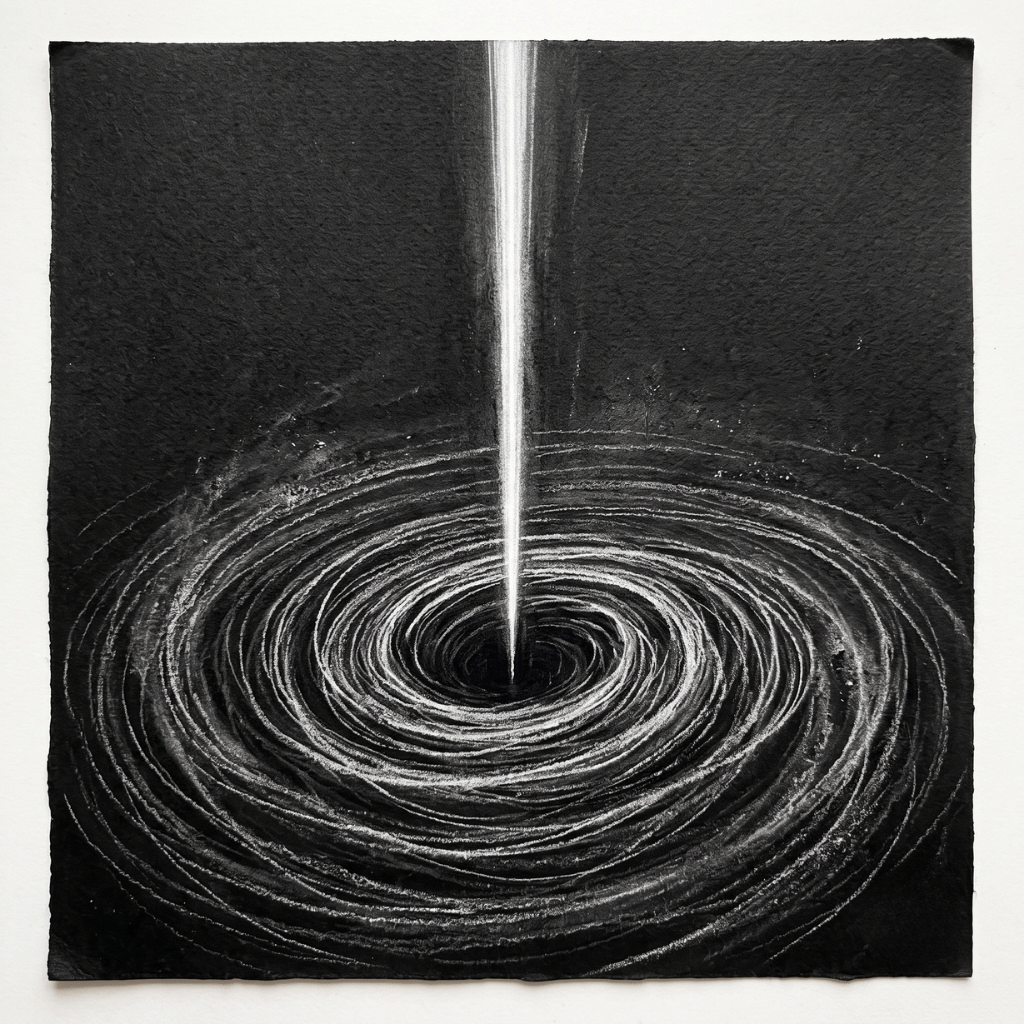
And here is another innovation of the Ari: this Empty Space is a womb. In the language of the Ari's Kabbalah, the Empty Space is opened within what is called Malchut de-Ein Sof — the feminine side of the Infinite. That is, all the universes are developing within a divine womb. Into this womb penetrates a straight line of the Light of the Infinite, which is called “Yesod de Ein Sof” — that is, a divine phallic light entering the womb — resembling a flute that plays melodies in the void. Each hole in the flute produces a different frequency that fills the entire space and generates realities. This is called "circles" in Kabbalah (igulim), which are an image of spheres filled with a particular frequency2. The Empty Space fills with worlds, universes. Each frequency generates one, and there are endless frequencies and endless universes.
Adam Kadmon - The Primordial Human
Ultimately — and I am making an insane abbreviation here — around this “flute” coalesces what is called Adam Kadmon (Primordial Human), in which the line of infinite light is the soul of this Adam Kadmon.
Adam Kadmon is what we would today call the blueprint of humanity — of what it is to be a human being. Kadmon in the sense of the primal, the primordial, the “arche” part of the word archetype. Not primitive, but the supreme archetype of all humanity. Imagine you are planning to create a creature, say a dragon: the dragon that exists in your mind contains all the possible dragons that anyone could ever draw — it is therefore a primordial dragon. So too Adam Kadmon is the totality of all human beings, all of humanity from its beginning to its end, everything that will pass over all the souls of humankind. Therefore Adam Kadmon is both male and female, and everything in between; it is both straight and gay and lesbian — everything that exists in humanity. Every human inclination exists in the blueprint of Primordial Human, called Adam Kadmon.
And then Adam Kadmon begins to become aware of his world. Where is his world? Within the Empty Space, of course. One could say: everything that exists within the Empty Space is what exists in the consciousness of Adam Kadmon — what he sees with his eyes, hears with his ears, senses in his consciousness.
Each and every one of us is a kind of Adam Kadmon. Everything you know about the world exists within you — there is no other place in which it exists. We are accustomed to thinking that we exist inside the world, and there is a kind of awakening that occurs when one understands that the world we think we are inside of is in fact within us. Truly. None of us has any capacity to be in contact with any world other than the world that appears through the brain's translation of the information arriving at our senses.
The creators of "The Matrix" put it this way: it may be that you are sitting right now in a capsule, connected to electrodes, and everything you see and sense is not real but is fed to you by the machine — and you have no capacity to disprove this, unless there is a glitch in the system. But to the essential point: the world we live in is the world that exists within us and is constructed by our brain. There may be other things — but that whose existence we do not know of simply does not exist for us. And the moment we become aware of its existence, it suddenly exists in our world, at least as a possibility — as, for example, dark energy and dark matter in modern physics. We have never met them, but like Goldilocks and the Three Bears, we posit their existence because "someone has been eating from my plate," said Papa Bear — that is, it left an impression.
The Shattering of the Vessels
And then the process of the Shattering of the Vessels (shevirat ha-kelim) begins. The shattering is described in the writings of the Ari as the shattering of the world that issues from the eyes of Adam Kadmon — also called the "World of Points" (olam ha-nekudim) — that is, his visual perception of the world, his view of reality, in which each thing is a point unto itself. The Shattering is also bound up with what one could say, the “sexual worldview” of the maturing of Adam Kadmon, for it is explained that the lights of the eyes spread out as a world from the navel of Adam Kadmon and downward. What we would today call "below the belt."
The World of Points is a world in which the balance between masculine and feminine forces3 is missing. The consequence of such limited construction is an inability to hold great and powerful lights — therefore it shatters. In the precise language of the kabbalists: there was no real zivug (coupling/union) in this world. For only when there is coupling between masculine and feminine can stability begin to form, and as long as there is no coupling — shattering is the inevitable consequence.
We can say that Olam HaNekudim, the world where the powers are separate, is Adam Kadmon’s adolescent stage, when his sexuality is still only a self-play, and the adolescent crises are an inevitable part of it. Maturity comes with the ability to create Zivug, which is a sacred union with an “other”.
I understand the Shattering of the Vessels as the shattering of comprehension and coherence. The shattering of the ability to create meaning. We, human beings, are “meaning-making machines,” but nevertheless we live in a broken world. Nature is not so broken — the ecological system in itself, without the human being, is relatively balanced. But the human world is broken and shattered, chiefly in the sense that we do not understand why and WTF?! We do not know why we were born, or why we will die, why our friends suffer, why we suffer, why good people suffer. We have no coherent picture of the world, and we try desperately to build one for ourselves. The human world is full of fractures, regrets, and traumas. It is a world whose vessels have shattered.
Trauma is one of the great expressions of the Shattering of the Vessels. In a course I gave — and intend to give again — "From Trauma to Initiation in Kabbalah," I argued that the Shattering of the Vessels is the way the kabbalistic language contends with the concept of trauma. Because what happens in trauma is that the intensity of the experience is greater than the psyche's capacity to digest it — just as it is said in the Ari's Kabbalah that the intensity of the light in the World of Points was greater than the vessels' capacity to contain it. And so, after the traumatic event, we have a shard of consciousness that is connected to nothing, that is not integrated, and like a shard has sharp edges. It did not pass through the digestive mechanisms (Kelim) of consciousness, and it sometimes takes control over us in post-traumatic events. The way to heal the shattering of the vessels is called “Tikun” — usually translated as “repair,” though, again, that translation does not capture the full meaning of this kabbalistic term. As we studied before, it is a process of reframing our lives in the Kintsugi way — the Japanese art of mending a broken vessel with gold, so that the fracture itself becomes the beauty.
Boundary, Numbers, Story (Sfar, Mispar, Sippur)
The beginning of the process of repairing anything is bound up with how we are able to tell it to ourselves — in the secret of what is written in Sefer Yetzirah, that the world was created "with boundary, and with numbers, and with story" (sfar, Mispar, sippur). These are no small matters: since the whole world exists in our consciousness, the whole world is a story, in the deep sense of the word — that is, the world that exists in our consciousness is a construct. A story is a story even if it is not coherent, even if it is paradoxical, full of torments and devoid of any sense — it is still a story. Whether the story is a well-written one is already another question, and this is precisely our work: to take our Book of Life and to tell it well.
On Rosh Hashanah (the Jewish New Year), we pray "inscribe us in the Book of Life”. In the Netaneh Tokef prayer of this day, it is said that "the signature of every person's hand is in it,” and Hasidism interpreted that we are the ones who write and sign ourselves in the Book of our Life. This, in my eyes, is the deeper meaning of the name "Netaneh Tokef”: “Tokef” from the language of authority and agency — a call to take ownership over our story and tell it well, through our life choices, and through the ways we frame the challenges life offers us.
By the very fact that we are alive, we are telling the story of our lives, moment by moment. At this moment, as we are together here online studying Kabbalah, we are expressing part of who we are — we are the ones drawn to this particular study. Remember that the word sippur (story) is connected in kabbalistic Hebrew to the concept of sapir (sapphire) — something that shines. To tell is to illuminate according to the Hasidic teachings. Every choice we make in life sheds light on who we are.
But the root S-F-R is connected first of all to the making of boundaries: sfar is a border in Hebrew. The creation of a boundary enables counting. In the perfect supernal Oneness there is no sfar and therefore nothing to count — in the language of the kabbalists: "and before One, what do you count?" Only when there is a boundary that cuts the one into two can we look back and say "there is one," and then count "two."
When there are a number of things — there are relationships between them. Because what, in fact, do numbers mean? Numbers are forms of relation. The number three is not the sign we write, nor three dots, nor three apples — three is the very specific form of relation that is made possible only among three things. As Sefer Yetzirah says: "three stones build six houses" — there are six combinations that can be made from three letters.
Carlo Rovelli, one of the foremost physicists of our generation, argues that the universe is not a universe of objects but a universe of relations: a thing does not exist except in relation to others. Not objects that stand in relations — the relations themselves are what exist. And in the way I understand Sefer Yetzirah — the boundary is what generates the possibility of relation; one boundary creates the number two and makes relationship possible. More boundaries generate more numbers and more relations, and infinite boundaries make possible infinite numbers, which mean infinite possibilities of relations — that is, infinite possible stories. For what is a story if not the connecting of dots: to take one thing that happened, connect it to another thing that happened, and to weave some meaning. All physics and mathematics, in this sense, are stories — not 'merely' stories, but stories in the deep sense: marvelous ways in which we learned that one thing can be connected to another.
And so we learned that sfar — boundary — makes possible mispar (number); and numbers make possible sippur (story, in its deep sense). And the larger the number, the more immense the quantity of possible relations and stories. Rabbi Nachman of Breslov said something very beautiful about this, meaningful for anyone who facilitates groups: when a person joins a group, the number of combinations rises exponentially. Two people — two combinations. Three people — and already there are six possible relations. Four — twenty-four, and five — one hundred and twenty. This, by the way, is what happens in polyamory: when you add a third person to the system — you have not added one person, you have added an immense quantity of possible stories. And when you facilitate a group of eighteen people and the nineteenth joins — the one who joined is someone who has a possible story with each and every one, and with every sub-group, such that one added person has raised the level of complexity of the system marvelously, creating a significant leap in the level of complexity.
Question: When one feels complete oneness with someone — is there any relationship there at all?
Pele: I think it is not really possible to feel complete oneness; there always remains a degree of separateness, and it is good that it is so. Because one who feels his partner is "entirely one with him" often turns the partner transparent — takes them for granted, like a hand: I don't say to my hand "how nice to see you this morning." We need a measure of otherness for there to be wonder in a relationship — curiosity, not-knowing, "who are you really?" The Great One does indeed wish to return to itself — but the wonder of creation occurs precisely by virtue of the sfar, the boundary, which is the separateness that makes relationship possible and healthier.
Since the quantity of particles in the universe is immense and even the number of human beings is measured in the billions — our reality is endless stories, and within them each of us navigates the story of their own life, from birth to death, and afterward as well.
Endless True Stories
It is important to understand that we did not say there are endless possible stories, and that only one of them is true. Rather, we said there are endless true stories. For the truth is multidimensional; it is rich beyond what any story can tell — like the parable of the blind men and the elephant.
You surely know "Rashomon," one of the essential films of the Japanese director Akira Kurosawa. An event occurred: a man and his wife walked through a forest and met a bandit; there was intercourse between the bandit and the woman, and the husband died. These are the facts. And from here — versions: did the bandit murder the husband and rape the woman, as she claims? Or did she desire the bandit and ask him to murder her domineering husband — an entirely different picture of reality? The film presents several points of view, each of which tells a story about what happened, and the film does not decide what "really" happened there. It shows that what happened can be told from different angles, and we cannot know which is the "correct" angle.
Add to this the angle of the flies, which does not appear in the film. From the flies' point of view, what happened in the forest is a celebration: there is blood, there is a corpse, there is a place to eat and mate, lay eggs and reproduce! Who murdered whom simply does not matter to them. Think of the angle of the birds, for whom there are now plenty of flies to devour. Not to mention the angle of the bacteria, for whom the death of an organism is an upheaval of civilizations. We are so preoccupied with the human story that we forget there are countless other angles unfolding simultaneously, and one cannot say they are not "true."
My dear friend David Deida has a little book of tiny meditations, deliberately titled Instant Enlightenment. One of the meditations there says something like: consider what happens when you take a shot of tequila — what happens to Fred, the bacterium sitting in your throat, how he and his whole family and offspring and community are annihilated in a single gulp. You think you are drinking a toast and celebrating with friends, and in that very moment a genocide is taking place in your throat. Deida is simply proposing that we shift perspective for a moment and become aware of another, additional story — not through the angle we are so accustomed to calling "reality."
So what is reality? Reality is endless stories occurring simultaneously, and within them we try to navigate and produce a narrative.
Narrow-Minded Narratives and the World of Chaos
The narrower and more one-dimensional our narrative is, the more fragile it is and the more prone to "the Shattering of the Vessels."
Remarkably, I heard these very things from one who was once my teacher, Rabbi Yitzchak Ginsburgh, when he spoke about Rav Kahane. Today people think Ginsburgh and Kahane were one and the same — but Kahane's slogan was "Only Thus" (Rak Kach). And Rabbi Ginsburgh said to me, when Kahane was assassinated: "Only Thus" — that is a slogan of the World of Chaos (olam ha-tohu). Anyone who thinks there is only one way to do things belongs to the World of Chaos (Nekudim) in which each sefirah was a queen unto itself, and there was no inclusion between the sefirot. Chesed held: only thus, only my way. Gevurah held: only this way. Every time we say "only thus," we produce some kind of coercive worldview.
A worldview of "only thus" stems from the desperate need to know the correct way (“ortho-doxy”). There is something exhilarating in that kind of certainty, a sense of "at last I understand how the world works" — but if I think that I've got God by the balls because my way is the one and only correct way — this is going to crash by the Shattering of the Vessels. On the other hand, there was once a bumper sticker in Israel that said "Only Love Will Win," and this is the same thing, because anything that is "only" is limited and one-dimensional and destined to shatter.
In the language of the Ari's Kabbalah: the kings of the World of Nekudim were kings without a mate. They had no zivug, no capacity to include the other — and therefore they lack complexity.
A narrow narrative is a narrative in which there is no “love making” with the "other." A narrative devoid of complexity is like the bed of Sodom. It produces suffering, and is destined to shatter. Most religions produce such narratives devoid of complexity — and by the word "religions" I do not mean only Judaism, Christianity, and Islam: contemporary ideologies too, from Communism to the “MeToo movement," from conspiracy theories to fascism — they are all what I call “religions”. Every "ism" that lacks complexity thinks it is the great expression of the truth and permits itself to trample others in the name of that truth - that is a “religion”. It is always important to remember, as the Baal Shem Tov taught, that there is bad within goodness and good within evil — like the yin-yang symbol, there is black within white and white within black.
Truth is recognizable precisely by its being able to be in zivug with the other, without erasing it. Sometimes the truest thing is precisely to remain in a genuine bewilderment of not-knowing, without collapsing into a counterfeit knowing. Like Job, and not like his companions: Job's companions came with small, orderly explanations, counterfeit coherent explanations for his suffering- that God Himself rejects at the end of the book, saying "you have not spoken of Me rightly, as My servant Job has." It is precisely Job — who refused the explanations and remained in the open, painful question, for whom the world did not add up, but who was authentic — it is he who spoke rightly. And this returns us to the Empty Space in Rabbi Nachman's teaching and to the silence of Moses: there are places in which the correct “story” is silence.
Who Am I Really
Let us sum up so far:
We spoke of the Supernal Delight; of the Empty Space; of Adam Kadmon who is formed within it, whose senses are all the universes; and of the Shattering of the Vessels, which occurs in the lights issuing from the eyes of Adam Kadmon — that is, in how he sees reality. The Shattering of the Vessels occurs when the vessels of our consciousness are unable to process the light, and after this shattering we fail to tell a story of truth, because the trauma makes us stammer, makes us "heavy of mouth," and we must sometimes learn to be silent in full presence before this gaping Empty Space, like an abyss that has no bottom.
Relatively recently, the activity of the brain's "Default Mode Network" was discovered — a network occupied, in every moment that we are simply staring or daydreaming, with creating a narrative that constructs the "I." We wake in the morning and remember who we are, where we woke, what our relationships are, and what our commitments are. This network is, in fact, occupied with the greatest philosophical questions of all: Who am I? What is the world in which I find myself? And what actions must I take? — even if we usually make do with answers at the most basic level, in which I remember what I'm called, where I woke, and that the first action I must take upon waking is to go pee, and I know where and how to do it. These are very important things that we take for granted.
But these same questions can also be asked at great depth if we add the word "really": for example, "Who am I really?” What is the secret of my soul? As Professor Yehuda Liebes showed in his research, the Ari was preoccupied with these questions regarding himself, his student Rabbi Chaim Vital, and his other students. Anyone who goes to analysis, anyone engaged in inner searching, and does not make do with "my name is such-and-such and I work at such-and-such" is in fact asking this question: Who am I really? What is the secret of my soul? What is this world really? And what is truly fitting to do here — not merely for the sake of survival, but for the sake of the awakening of consciousness. The moment we introduce this added depth into the questions of the default mode network, they become the deepest questions there are.
The Why and the How
Nietzsche said: “One who has a why to live for will bear almost any how”. Viktor Frankl quoted him in "Man's Search for Meaning," and Hersh Goldberg-Polin, may he rest in peace, repeated this saying often while held captive in the Hamas tunnels in Gaza. Eli Sharabi, in his book "Hostage," tells that this sentence kept them alive there. Hersh himself was murdered there, but those who were not shot to death — this thing kept them alive.
On the other side of Nietzsche stands Joseph Campbell, who in his book "The Power of Myth" says: I don't think people are really seeking the meaning of life, but rather the experience of aliveness itself. When we are experiencing aliveness, we don't ask what it means.
Campbell and Frankl are both right, in my view. The one speaks of the desired state, in which we are truly living radically, and then we do not ask why — we simply live. The other speaks of all the hard states in life when we do not feel alive, when we are emptied out, when the world collapses upon us — in those moments we need a meaning good enough to survive the terrible how — until the aliveness returns to the system, and we might forget we ever asked.
Trauma as an Undigested Experience
Trauma, as we said, is an experience we are unable to digest. The intensity of the experience is what is called in Kabbalah "great lights," and when the vessels cannot contain these lights, they crash. Experiences require processing, and this processing is much like the processing of food in the digestive system: we eat a cucumber, extract from it the minerals, water, and what is relevant to our health — and the rest we expel, and give back to nature, with due respect. This is what the brain is meant to do with experiences: something happened, I digest it, learn from it what is meaningful for my life, and release the rest of the details. This is why we forget millions of details in every moment.
But when we encounter horror and terror — it is often too big for our capacity to digest, and therefore no detail can be released either: the shirt of that person, the smell of the wet dog that just passed by you — nothing is released from memory. Trauma is a capsule of experience that cannot be digested. And so various methods of treating trauma — like EMDR, by means of eye movement — try to enable the brain to take the stuck experience and finally move it through a process of digestion. The moment an experience is digested, the irrelevant details are released, and the relevant ones remain — and even if they are hard, they are precise: of whom and of what one truly needs to beware, and of whom not, even if he wears the same shirt.
The problem with trauma is that it connects irrelevant dots to relevant ones, and therefore tells a false story about reality. When many Israelis, after the horrors of October 7th, think that "all Arabs are dangerous" — this is a generalization that is a product of trauma. And not only is it untrue, since there are plenty of Jews who are dangerous and plenty of Arabs who are not, but it leads to wars that cause more and more trauma. That is, trauma creates a loop that worsens the situation. When we cannot process an experience, we are unable to distinguish relevant from irrelevant information, and lead ourselves astray.
Tikun Olan: A Multidimensional Story
And here I arrive at my interpretation of the Ari's Kabbalah: the Repair of the Sparks (tikkun ha-nitzotzot) is a process of constructing true and deep meaning, of connecting dots into a story that has sufficient depth. A story that is not post-traumatic, that is not arrogant and violent, a story that does not claim "only thus," but rather a story that holds insight founded upon humility.
Hasidism emphasizes that what builds the World of Tikun is humility — or, in the language of the Ari's Kabbalah, a certain combination of the letters of the Holy Name, that is the power of Anava — humility. A humble person, or nation, does not think it knows everything, and therefore honors the other in their otherness.
Our task, in my eyes, is to gather fragments of life into what I call “a good story”. A story that is “larger than life”, because for your real story, the story of your soul, it is worth living for. The world was created as a story. The world itself is a book. The invitation is to take as many moments of life experiences and feel them as bearing wide and deep meaning. Not necessarily a meaning that can be spoken in words.
This, in my eyes, is the process of the clarification and repair of the holy sparks that fell in the Shattering of the vessels. And the deeper and more inclusive our narrative — due to humility — the more it releases us from suffering (not from pain, but from suffering, which are not the same thing, as is known).
In every choice we make in our lives, we unfold our soul's story. But note that this process does not end at what is called "death." When a person dies, they become a story. A story told about them by those who remember them. Certain people’s stories resonate with some collective unconscious archetype, and they become mythic figures.
Consider, for example, the scholarly hypotheses arguing that Abraham, our father, was not a private individual but a name for an ethnic group that migrated from Mesopotamia to Canaan in the Bronze Age. In this group there were men, women, children, and elders; they had lives, they suffered and loved and hated one another, they quarreled and reconciled, they made love, and eventually they died. What remained of them? What remained is a story about a group, which over the years received an encompassing name of an archetypical individual "Abraham" — that became a national myth. Everyone alive in the whole world today has their fate affected — willingly or not — by the people whose national story is bound up with that "Abraham." The concrete people who lived in the Bronze Age became one mythological character, and thus their story has not ended. The sparks they set in motion in the world are still very much active.
The Countenances (Partzufim)
According to the Ari's Kabbalah, the Tikun produces partzufim (countenances) where before there were only isolated sefirot. Partzuf means a whole figure, and the Divine in the Kabbala of the Ari appears in different figures. Sometimes God appears to us as a very old human. Sometimes as a youth, sometimes as male and sometimes as female — and all are different appearances of the Great Oneness.
In the Ari's Kabbalah there are five principal countenances: Atik Yomin — the Ancient One, in whom there is no distinction between male and female; Abba and Imma — the Supernal Father and the Supernal Mother; Zeir Anpin — who is the young God, the warrior and the lover; and the Shekhinah, his mate, the beautiful and beloved Goddess, who is also our merciful Mother.
The Divine in the Ari's Kabbalah appears as a masquerade ball. The unattainable One appears in various masks and divine figures, and each such partzuf contains all the sefirot, just as every human being is composed of a nose, ears, and ten toes. The great transition the Ari made is from a Kabbalah of sefirot — like Chesed, Gevurah, and Tiferet — to a Kabbalah of whole figures, among whom there are complex relationships, and all of them together are expressions of the One that is beyond the beyond.
For intellectual integrity, it should be said that this was already written in the most ancient Indian Vedas. In the Rig-Veda it is said: “Ekam sat, viprā bahudhā vadanti” — Truth is one, and the wise call it by many names.
This conception — that Truth is one and has many faces, like a diamond — is itself also a "story." But it is a multidimensional story, a story of Tikun, a story that does not generate dispute and strife, a story that contains different ways of seeing within a single story, a story that has in it contentment and a smile — and therefore it makes peace possible. Shalom from the language of shalem (whole): a more whole, more inclusive picture of the world. The repair of the Shattering, according to the Ari's Kabbalah, creates the World of Countenances (Partzufim) that makes room for sacred pluralism.
The Egg
At this stage, we read together the short story "The Egg" by Andy Weir (link: The Egg)
For the benefit of those who were not present, let us say that the story — excellently written and worth reading — tells of a man who is killed in a car accident and meets God, who reveals to him that he is about to reincarnate again — and not only that, but that all human beings who were and will be, in all times, are reincarnations of himself; the entire universe was created just for him, like an egg within which he ripens, incarnation after incarnation, until he ripens to be born and be "God".
How is this story connected to the Ari's Kabbalah? Here are some of the points that arose in the conversation:
The Empty Space and all the worlds within it are one great egg, or womb. Within it, one human being develops — "Adam Kadmon" — and this human being is all the human beings who were and will be.
What this Primordial Human does all the time is to pass through all the crises of life and death, and through this to mature, and be, ultimately, kind toward himself.
The Serpent Who Spoke Truth
And here I will recall what we learned not long ago in "The Tale of the Seven Beggars" by Rabbi Nachman of Breslov: of what is time composed? Of "kindnesses of truth" (chasdim shel emet). And if we look at this within the parable of the egg — each time we do an act of kindness, and especially a kindness of truth, we do a kindness with ourselves. The tissue within the egg becomes more and more coherent; we produce an organic texture within all that is within the egg. And the more we do good to ourselves — which is everyone — the easier it is for us to recognize our divine nature. It is like climbing a mountain: the surroundings are the same, but from above one sees better. In reality, there is nothing but God; but the more we do good, the clearer the perception becomes, and we see the Divine in everything.
According to the story of the Egg, when we finally ripen, we will become God. This is what the serpent said to us already in the Garden of Eden: "and you shall be as God." The serpent — who is, as is known, the soul of the Messiah — spoke the truth; he simply did not mention that it would take several billion incarnations. But from the place he comes from, a place in which there is no time, this is peanuts.
Summary: How to Ride the Chariot
So if we are to sum up — here is how it seems to me one rides the Merkava that the Ari had described: by gathering more and more moments of life that appear broken and disconnected and devoid of sense into a "good story," one that is truly "larger than life" — and of course, a really good story contains silence too. The more our story has ripened, the more humble it is, the less zealous and arrogant it is. But the condition is that our story must be true. One cannot sugarcoat reality with various spiritual bypasses and thereby supposedly solve the problem. And this too must be remembered: every meaning we have about life will be revealed in retrospect, after we advance, as a kind of training wheels that were necessary for the previous stage. It may well be that we will look back and say that the great truth of yesterday was merely a partial story. The more we grow, the more we look at the stories we told in the past and smile. We need fewer words and more wrinkles of joy to tell our life story to ourselves.
It seems to me that the more we grow spiritually, the more humor we find in existence. Because ultimately this whole universe is a part of the supernal delight. And thus we have returned to the starting point: this whole egg is one great dupernal delight.
In every good film there is some distress; the characters suffer — but as viewers we enjoy it greatly. We draw artistic pleasure from the story as a whole. From this perspective, it is "worth it" for the characters in the film to have gone through all they endured. It is all part of the art, part of the delight.
Emptiness and Redemption
The purpose of all the work we do with the sparks according to the Ari is to lead to complete Redemption — Geula Shlema. I relate to the concept of redemption as the awakening of human consciousness to its divine nature — like the ripening of"The Egg."
The path goes through purifying the holy spark within each moment of life, through the Point of Nothingness (nekudat ha-ayin) at its center — what I call, with Jewish humor, "the hole in the bagel."
Every moment in our lives is "perforated": it has an inner point, a point of nothingness, which is like a void. Usually we evade touching that point, because it feels too vulnerable to us, and we prefer to don armor. The more we flee from the inner point that is the heart of the matter — the more we miss the mark, and live rather shallow lives. On the other hand, the more we draw near to the inner point, the more depths open in our lives. And when we truly touch that point, it is as though we have touched God, and our perception of reality changes completely.
The path to the inner point of each moment passes through vulnerability. It is not comfortable for us to feel vulnerable, and so when we draw near to the inner point we at first feel a contraction, because we are afraid — but the moment we touch that inner point, something opens, and we find ourselves in a whole different field.
And let us not be mistaken: there is no formula for this. Vulnerability is not "telling my darkest secret" — exposing information is not the same as revealing the soul. Sometimes the inner point of a given moment is a shared silence, a look in the eyes; sometimes it is speaking a truth no one dares to express; sometimes it is a touch, sometimes noticing a passing bird. Each moment has its own inner point, one of a kind, and the only question is: how capable am I of being attentive, curious, and sensitive to it?
What is the inner point of this moment, the like of which has never been? Every moment whose center is touched — even the most banal moment, like walking down the street, paying the cashier at the supermarket or brushing your teeth — is suddenly charged with a divine tremor. A holy moment is a moment whose center has been touched. Every moment whose inner point has been activated is revealed as holy.
In the language of our Kabbalah, this is the meaning of the word mitzvah — from the language of tzavta, togetherness, connection. That moment, in which the point of nothingness within it has been revealed, becomes a bead that can be strung onto the prayer-beads of life itself. Every experience is a bead, and the beads are bound to one another through the void at their center. Thus is woven what I call the "story" in the Book of Life — not through the outer shell of the experiences, but through presence at the point of nothingness at their core.
When all the moments are completed in this way — and this can take billions of years; for in eternity the quantity of time is not an issue — the whole strand will be reconnected. And this is the meaning of the complete awakening: not the awakening of an individual — the individual in any case does not truly exist — but the awakening of the consciousness of the entire universe, a universe becoming aware of its own divinity.
So what was the secret that led to the Ari being taken from the world? I think that what the Ari could not fully reveal is the divinity of the human being — including through its sexuality. Consciousness in the sixteenth century was not ready for this. But the story of the holy Ari is still being told: we, at this very moment, are binding the soul of the Ari to the language of awareness of our time — and the aliveness of that soul-root is still acting within us, in these very moments.
Ultimately, the whole world is a composition of mathematics and language, as was already said in Sefer Yetzirah thousands of years ago — that is, the whole world is a kind of text. And for this reason, the art of hermeneutics — the art of reading and interpreting texts — we are called to apply to the great Text, which is the world itself.
Closing Blessing
With this we will conclude for today. May we all merit great illuminations from our soul — which is also the soul of the Ari, for we are all incarnations of that one. On this day we are all the holy Ari, and we are all, in the end, also God.
Thank you very much, and until we meet again — Shalom.